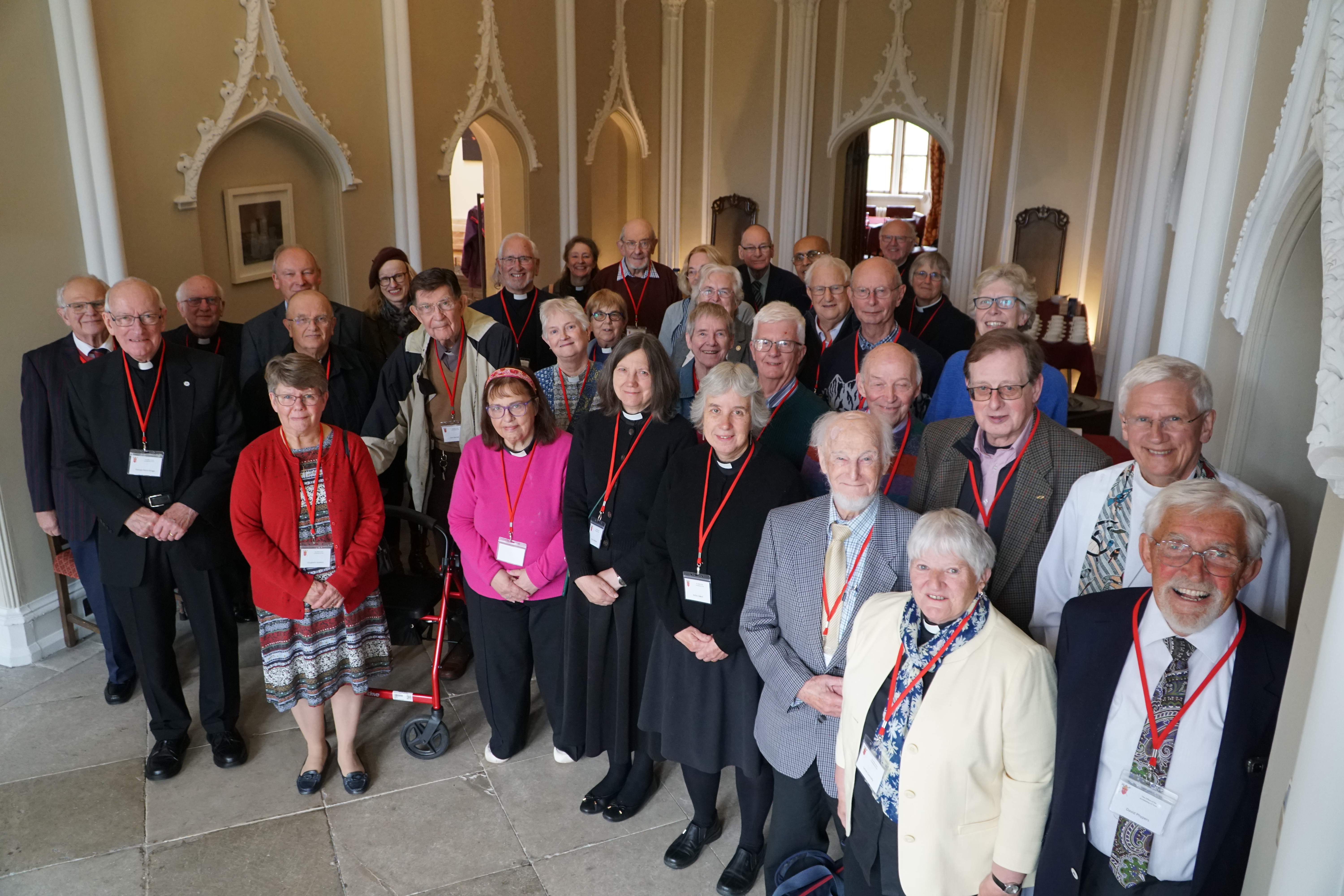
Members gathered at our Annual Meeting at Bishopthorpe Palace 25th September 2024
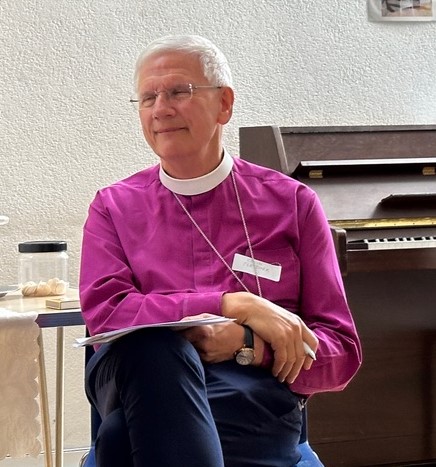
Our President, Karen Gorham, Bishop of Sherborne
We have a number of key aims:
- To foster the continuing ministry of retired clergy.
- To support and encourage retired clergy.
- To encourage retired clergy to meet.
- To represent the interests of retired clergy at national level.
- To keep retired clergy aware of changes in liturgical usage and professional conduct.
- To encourage and support bishops in their pastoral responsibilities.
- To become a community of prayer.
*** The significant proposals to improve Clergy Pensions are explored and examined on our ‘Useful Information’ page ***
*** The new House of Bishop’s Policy and Guidance on PTO are included in our @useful Information Page ***
In January 2020 we published a major report which seeks to offer key data regarding the numbers, spread and involvement of retired clergy across the Church of England. The link to the report can be found on the ‘Useful Information’ page.
In 2024 we commissioned a major report by Julian Hubbard on ‘The Role and Work of Retired Clergy Officers in the Dioceses of the Church of England’ which can also be found on the Useful Information’ page.
By following the selections above you will find more information about who we are and what we do, how you may join us or meet with fellow retired clergy. You will also find links to a lot of useful information.
A Word of Welcome from our Chairman, Bishop Colin Fletcher
Soon after I retired as the Bishop of Dorchester in November 2020, our then President, the Bishop of Guildford, asked me if I would consider being nominated to become the next Chairman of the Retired Clergy Association. After taking stock of what it might involve I said that I would be delighted to do so, and I am finding it to be a very fulfilling role within my retirement ministry.
As its name implies the RCA is an Association for Retired Clergy, seeking to help those who belong to it both in their ministries and in their lives in general. In practice that means that most of what we do benefits all Retired Clergy, whether or not they are members of the RCA, but without the work of the Association many good things would be lost.
The reason for that is that we are the only National Body dedicated to serving those clergy who have retired and our role is made all the more important because we are often very poorly represented both in Diocesan Synods or at the General Synod and at Bishop’s Staff Meetings, despite the fact that much of the regular worship of the Church of England would come to a halt without us. Together with our Vice Chairman and Secretary I meet every six months with representatives of the Pensions Board, the National Safeguarding Team, and members of the other NCI’s including the Ministry Division, and Human Resources to ensure, as best we can, that the needs of Retired Clergy, and their continuing significance in the life of our church are given proper consideration. Recently we have been consulted on the reworking of the policies with respect to ‘Permission to Officiate’ and we have also been successful in a number of dioceses in promoting the PTO pathway for safeguarding training. We also commissioned two key pieces of research, led by The Venerable Julian Hubbard on The Numbers, Spread and Involvement of Retired Clergy across the Church of England and, more recently, The Role and Work of Retired Clergy Officers in the Dioceses of the Church of England. Coupled with the former we also did some research on the fees that are being offered by different dioceses for such things as Sunday Duty and this has prompted further discussions at National Level.
Another area of concern which we are still investigating, and hope to produce some solid statistical evidence on in due course, relates to the scandal whereby ordinands entering training were required to sell their houses to pay for the costs involved – but always with the promise by a representative of their sponsoring diocese that they had no need to be concerned as the Church would always look after their housing needs in retirement. That promise, which it did not make in the first place, is something that the Pensions Board now wrestles with on a daily basis and the letters I receive regularly from clergy whose lives were, and are, badly affected by this policy make for very salutary reading.
Not all of our concerns have finance close to their heart. I’m grateful for the work that Mauro Fornasiero and John Eatock are pioneering on the provision made in different dioceses for those approaching retirement and, in particular, the whole question of spiritual flourishing in retirement itself. It is good too to hear of those dioceses where Continuing Ministerial Development programmes are being opened up to all clergy with Licences and PTO’s rather than being restricted to their Stipendiary Priests.
To keep in touch with our members we produce a newsletter four times a year. The right to receive this goes with membership of the Association, and its one-off £50 lifetime subscription which most dioceses have agreed to pay, in accordance with the House of Bishops’ Guidance, on retirement.
Looking ahead our Church is going to continue to face many major challenges, but its life-blood will, I believe, continue to flow in our parishes up and down the country. Retired Clergy, as Julian’s research has shown, play a vital role in maintaining the rhythm of worship and prayer as we continue to serve the people of this land and, on behalf of the Association, I welcome all who are able to join with us in their continuing service of God and His people.
+Colin Fletcher

 Retired Clergy Association